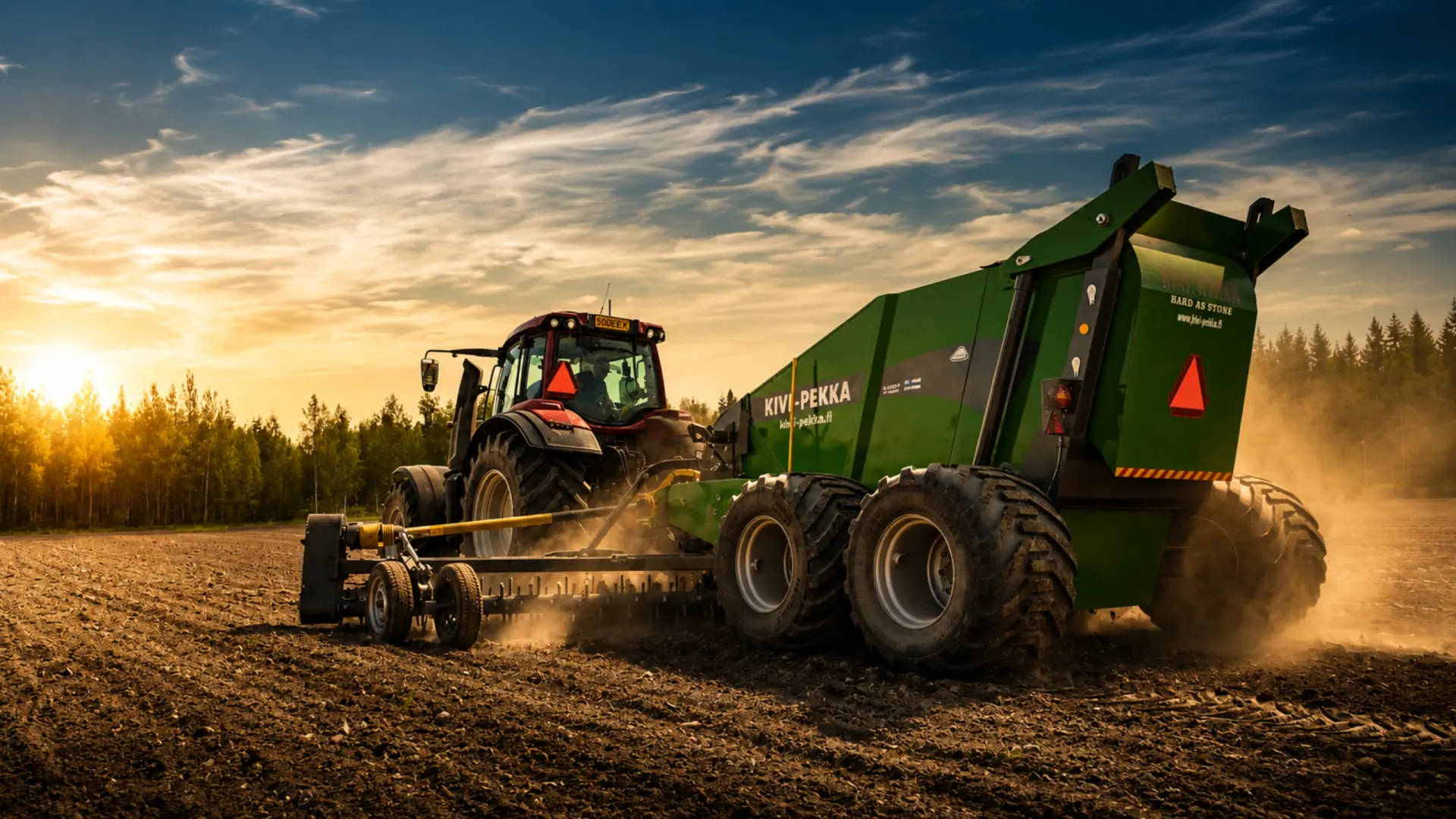
Stones in the field are a problem that farmers in northern and eastern Poland know all too well, and farmers elsewhere in the country sometimes not well enough. On glacial areas (Masuria, Podlasie, Pomerania, parts of Warmia and Suwałki region), stones “come out” of the soil after every winter: the freeze-thaw cycle lifts them from deeper layers towards the surface. By spring, a field that looked clear in autumn is again strewn with boulders from a few centimetres to several dozen centimetres in diameter. On top of that comes the daily cost: punctured tyres, bent ploughshares, damaged coulters, blades replaced on the combine.
Hand-picking stones is work that eats up working days and does not scale to larger areas. The alternative is machines specialised in one task: separating stones from the soil and removing them from the field. The Finnish brand Kivi-Pekka, produced by PEL-Tuote Oy of Rantasalmi since 1997, is the reference in this segment; its stone collectors work in more than 50 countries.
How mechanical stone collection works: three-stage soil separation
A stone collector is not a “basket on wheels”. Kivi-Pekka machines use a three-stage soil separation system, described in the company brochure ENG 2025:
1. **Screen under the lifting drum.** The topsoil together with the stones passes onto a screen placed under the lifting drum, whose tines are matched to the size of the stone sought (Ø from 2.5 cm for standard models, from 3.5 cm for model 7 with Flex Drum). 2. **Transfer to the hopper, soil returns to the field.** The stones move into the stone hopper; the earth that has sifted through the screen falls back onto the field. The valuable topsoil stays where it should be. 3. **Container for residual soil.** Soil that did not sift through during stage 2 goes into a separate container behind the rear wall of the hopper and is released when the stones are unloaded. Again, it returns to the soil, not onto a heap together with the stones.
Result: the hopper mainly receives stone. There are no valuable tonnes of earth in the pile and no barren heaps of clay on the field. Hopper unloading (in models 4–7) reaches 2.9 metres, so stones can be loaded directly onto a trailer with sides up to 2.7 m or onto a lorry, without unloading onto the ground first.
Flex Drum: flexible drum for the largest boulders
Oversized stones are a separate story: the “too big” ones that are normally pulled out by hand with a chain from the tractor, and which a rigid drum would simply jam the machine on. The solution is the **Flex Drum**, a flexible lifting drum with a hydraulic pressure accumulator. The drum drive runs along its frame, so the whole frame can yield upwards and the drum “passes over” the stone instead of getting blocked by it. The range grows from Ø 2.5–35 cm (without Flex Drum) to Ø 50 cm.
Where Flex Drum is available:
- **Kivi-Pekka 5** and **Kivi-Pekka 6**: optional. - **Kivi-Pekka 7**: standard (33 heavy-duty tines 13×50 mm). - **Kivi-Pekka 3.3** and **Kivi-Pekka 4**: not available (range Ø 2.5–35 cm with the classic drum).
Flex Drum can be paired with the optional **ISOBUS automation package**: an ultrasonic sensor maintains working depth, and when a jam occurs the system automatically unloads the rotors and lifts the drum; once the blockage clears, the machine returns to work. At the headland one button is enough to raise the machine and stop discharge. Automation is available only in versions with Flex Drum.
Choosing a model for area and tractor
The range has five collectors, differing in working width, capacity and tractor requirements. A short comparison from the manufacturer's technical table (brochure ENG 2025):
- **3.3**: 3.3 m, up to 900 kg/min, 5 m³ hopper, tractor from 60 hp. Compact, manoeuvrable, also for specialist crops and site development (roads, buildings). Unloading height 2.1 m. No Flex Drum, no ISOBUS. - **4**: 4 m, up to 700 kg/min, 3 m³ hopper, tractor from 70 hp. Kivi-Pekka calls this model a “reliable and cost-efficient powerhouse”, a proven starting point for smaller farms and contract services. No Flex Drum. - **5**: 5 m, up to 1000 kg/min, 3 m³ hopper, tractor from 80 hp. The range's “long-time favourite”. Flex Drum optional. - **6**: 6 m, up to 1200 kg/min, 3 m³ hopper, tractor from 80 hp. Large areas, same power class as model 5. Flex Drum optional. - **7**: 7 m, up to 1400 kg/min, 5 m³ hopper, tractor from 100 hp. The flagship model, Flex Drum as standard, 560/60×22.5 tyres on tandem axle. For large areas and demanding contract work.
A detailed comparison of models 5 and 7 can be found in the comparison on the Kivi-Pekka 7 model page.
When buying a stone collector pays off: what to look at realistically
“ROI within a year” is easy to write and hard to prove on a specific farm. It is more honest to consider three questions:
**1. Do stones really cost you money every season?** Replaced seed drill coulters, punctured trailer and combine tyres, bent blades and ploughshares, downtime for replacing tines on the implement, damage to plough shares: if this is a list that comes back after every harvest, a high answer is a signal that the cost of neglect grows together with the machine fleet.
**2. How many hectares are involved and how are they distributed?** The 3.3 model (60 hp) makes sense on smaller, scattered plots and with specialist crops. Models 5–7 (80–100 hp) suit a contiguous area where working width translates directly into hectares per day. Contract work also enters the calculation: a well-maintained model 5 or 6 can serve neighbours within a radius of a dozen or so kilometres.
**3. Do you have somewhere to put the stone?** The collector does not make the stone disappear; it carries it to a designated place (field boundary, heap, yard). The 2.9 m unloading height (models 4–7) allows loading onto tipper trucks and using the stone in roads, construction or surfacing yards. The 3.3 model with 2.1 m unloading is better suited to discharging into a trailer.
If your answers to these three questions are “yes, a lot, I have it”, it is worth working through a specific case with a dealer. At RUTHENIA ALBA we make such a calculation free of charge, based on your area, tractor and the maintenance cost history of your seed drill and combine. Write via zapytaj or check how financing works.
Common myths: a quick filter
- **“Stone collection damages soil structure.”** No: three-stage separation is designed to return the topsoil to the field. Only stone goes into the hopper, not earth. - **“Kivi-Pekka makes disc harrows.”** No: it is a stone collector. Kivi-Pekka does NOT make disc harrows or rollers. If you are looking for a seed drill for soil work after stone collection, see Finnish Tume seed drills (PEL-Tuote has been a shareholder of Tume-Agri Oy since 2017). - **“Flex Drum is in every model.”** No: only in models 5, 6 (optional) and 7 (standard). In the 3.3 and 4 the stone range is Ø 2.5–35 cm. - **“ISOBUS automation can be added to any collector.”** No: the automation package is available only in versions with Flex Drum.
Summary
A stone collector makes sense where a glacial field “produces” stone every year and the machine fleet, especially the seed drill, tyres and combine, really pays for it. Since 1997 Kivi-Pekka has specialised in one thing: effective three-stage soil separation that keeps the topsoil on the field. Choosing a model (3.3, 4, 5, 6 or 7) depends on area, tractor class and whether you need Flex Drum for really large stones. Starting point: the brand page and the model comparison.